Be it helping you to build the best cello for the salty humid Dubrovnik climate that sounds like a "Stradivarius". Or as the inside joke... helping you build wooden poles that are more invisible to modern radar as they are water-free, one thing is for sure. Whatever crazy idea you have we just blink once... wait 3 seconds, then we'll say ok brother. Let's see the science behind it, how it can be done. Like, look at the roots below/above:
The Tectonic Struggle of the Citadel Root
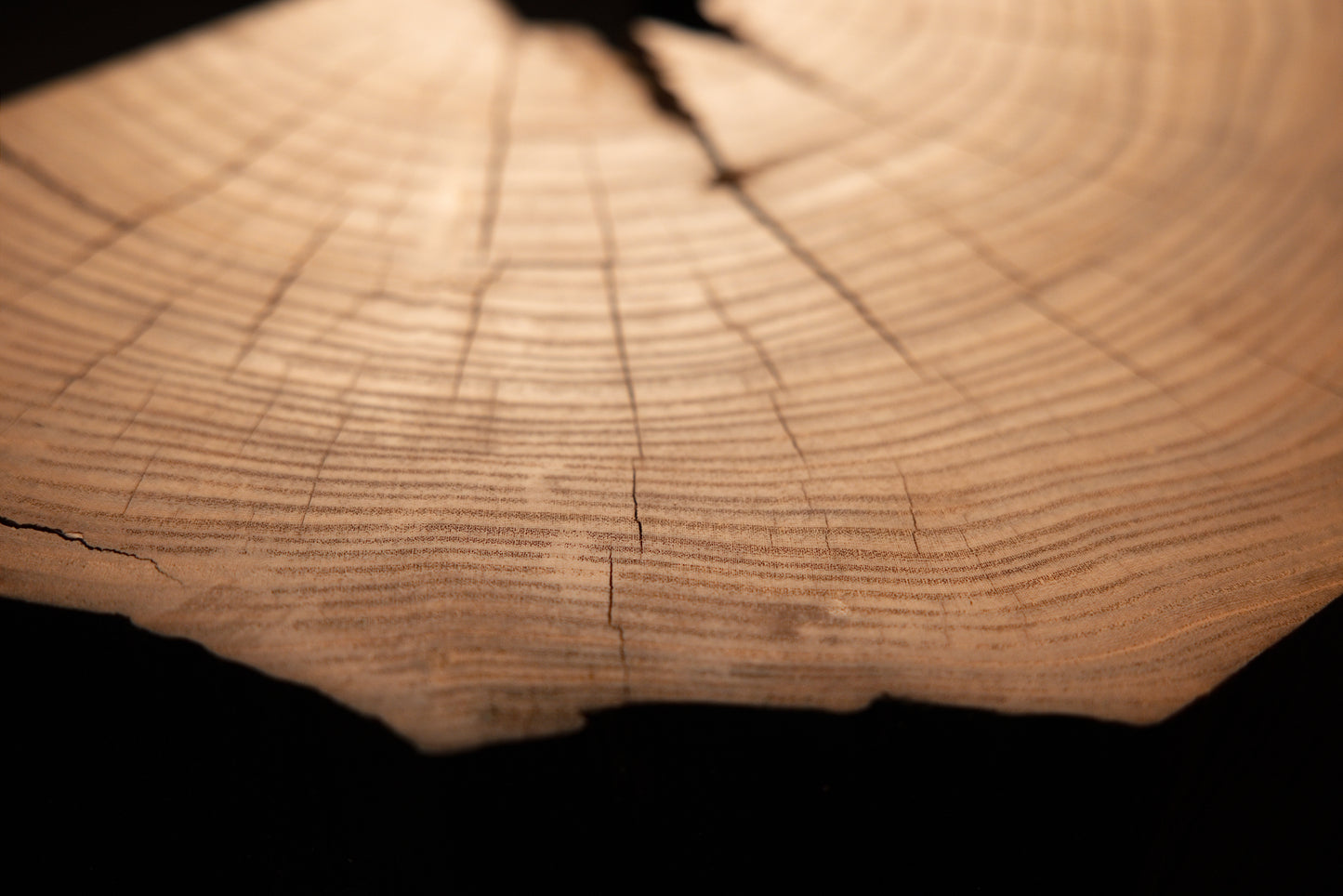
When you trace the frantic, twisting geometry of Item 034, you are witnessing a physical record of resistance. Excavated from the city center of Oradea, just south of the historic Citadel, this root did not grow in soft, yielding earth. It fought its way through a highly compressed, brutal bed of hard clay. The violent, swirling shapes and undulating grain patterns are the exact botanical blueprint of a constant, tectonic struggle to expand in an environment that refused to yield.
The Peța Floods & Mineral Saturation
As it fought the impenetrable clay, this area was continually submerged by mineral waters. This specific geography was endlessly flooded by the thermal, mineral-rich waters of the nearby Peța river or by Crisul Repede river. Acting as a massive subterranean sponge, the root soaked up these heavy minerals for decades accumulated in the soil. This relentless mineral saturation fundamentally altered the timber. Look at the explosive golden-amber hues that radiate from the dense grain today.
Forged in Fire: The Architecture of Contrast
At KovaKelo, we do not use artificial stains or chemical dyes to highlight natural geometry. To accentuate the intense, rolling chatoyancy of this mineral-soaked amber heartwood, we intervened with fire. Using a traditional Japanese burning technique, we strategically charred specific sections of the monolith into a pure, pitch-black carbon crust. This creates a brutal, high-contrast visual boundary. The deep blackness frames the wood, forcing the eye to process the depth of the golden hues and making the natural chatoyancy visually erupt against the charred exterior.
Monolithic Gravity & Spatial Curation
This is not a delicate wooden fragment; it is a massive, incredibly heavy monolithic organism. Its sheer physical mass and aggressive, contrasting colors command the visual weight of any room it occupies. Engineered to serve as a freestanding biophilic monument for luxury executive suites or high-end commercial spaces, it provides an awe-inspiring haptic anchor. Through our Sovereign Node pipeline, elite architects can access the precise 3D digital twin (.obj, .fbx) of this exact root, ensuring flawless parametric curation before this heavy piece of geological history ever leaves our facility.