Executive Overview
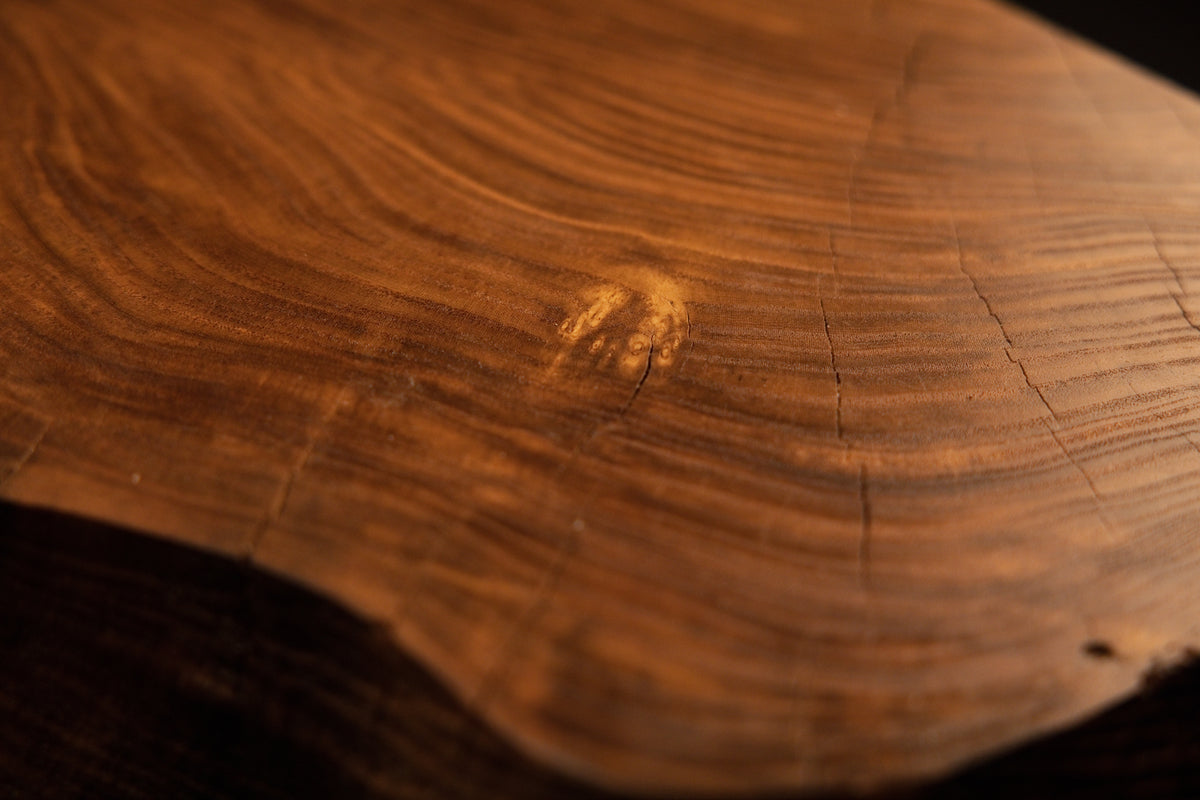
Monumental, single-slice cross-cut (cookie) solid hardwood end-grain butcher blocks and freestanding Michelin-grade chef prep islands—sawn up to two meters in diameter from a single ancient Carpathian tree trunk. Engineered through deep-core hygroscopically stabilized thermal conditioning and concealed internal radial tensioning to drastically minimize the classic Pac-Man pie-wedge splitting of cross-cut rounds—replacing the 150 or more synthetic chemical glue seams of conventional laminated cube butcher blocks with one unbroken, naturally antimicrobial field of vertical wood fibers.
Atelier Note: Slicing on true end-grain is a completely different universe than cutting on a standard wooden board. On normal flat-grain wood, a knife blade slices across horizontal fibers, permanently scarring the surface and rapidly dulling expensive Japanese steel. On end-grain, the wood fibers stand vertically like the dense bristles of a paintbrush: a razor-sharp blade simply "slips between" the vertical fibers without severing them, and the wood naturally closes back up when the knife lifts. But for woodworkers, a giant tree round is a structural nightmare. Because tangential shrinkage around the outer circumference is two to three times faster than radial shrinkage from the center, a drying tree cookie inevitably rips itself open like a giant Pac-Man mouth from the bark to the core. Historic butchers solved this with heavy blacksmith-forged iron barrel hoops bolted around the outside. In a modern luxury kitchen, you don't want an ugly medieval iron strap around your island. At KovaKelo, we engineer deep-core hygroscopic stabilization and concealed structural tension engineering that neutralizes circumferential hoop stress from the inside—giving you an indestructible, self-healing culinary monument.
The Architectural Physics Problem: Why Laminated Cube Butcher Blocks Delaminate and Cross-Cut Tree Rounds Split
Serious culinary professionals, master butchers, and luxury residential chefs universally prefer cutting on end-grain hardwood: because the wood fibers stand vertically like a dense bundle of microscopic bristles, a razor-sharp Japanese or German chef's knife parts the fibers rather than severing them—preserving knife edges and naturally drawing bacteria down where they die through capillary desiccation.
Yet until now, anyone wanting a massive end-grain culinary island had to choose between two deeply flawed options:
The 200-Glue-Seam Checkerboard Block Failure
Standard commercial end-grain butcher blocks are fabricated by gluing hundreds of small, two-inch-square wood cubes together using synthetic polyvinyl acetate (PVA) or polyurethane adhesives. In a real kitchen—subjected to daily hot-water scrubbing, bloody meat juices, hot pans, and dry winter underfloor heating underneath—adjacent cubes expand and contract at slightly different rates. Within months, dozens of glue seams open up into microscopic hair-thin crevices that trap raw meat proteins, turn black with mildew, and force the chef's knife blade to click across hard synthetic glue lines with every chop.
The Classic Pac-Man Wedge Split in Whole Tree Rounds
Conversely, if a sawmill slices a thick cross-cut disc (cookie) straight across a massive oak, beech, or walnut trunk and dries it conventionally, the laws of wood anatomy guarantee a catastrophic radial split. Because a tree trunk shrinks roughly twice as much tangentially (around the circumference of the growth rings) as it does radially (from pith center to bark), the circumference becomes too short for its radius as it dries. The disc relieves this geometric impossibility by ripping open a massive, 40-to-80-millimeter-wide pie-shaped wedge crack from the outer bark right into the central heart.
The KovaKelo Turnkey Execution: One Continuous Trunk Cross-Section, Zero Glue Seams
At KovaKelo, we conquer the radial-to-tangential geometry of whole-trunk cross-sections—delivering genuine, single-slice end-grain culinary monoliths without checkerboard glue grids or epoxy pie-wedge fills.
High-Density Species Selection and 2-Meter Cross-Cut Milling
From our KovaKelo Botanical Index of 140 Carpathian Wood Species, we select tight-grained, knife-friendly culinary hardwoods—including Dense Mountain Beech, European Hornbeam, Sycamore Maple, Wild Cherry, European Walnut, and Closed-Tannin Sessile Oak—up to 2,000 millimeters in diameter. Using our heavy-log precision saws, we cut thick, 120-to-300-millimeter end-grain rounds with uniform axial flatness.
Deep-Core Hygroscopic Stabilization and Radial Stress Neutralization
Rather than letting a thick cross-cut round dry unevenly in open air (where the exposed end-grain pores evaporate moisture ten times faster than side-grain, causing instant surface checking), KovaKelo immediately places the green or pre-conditioned round into our computer-controlled parallel hygroscopic stabilization chambers. By regulating vapor pressure and executing our chemical-free sub-pyrolytic conditioning cycle across the entire cross-section simultaneously, we relax the tangential hoop stress at the cellular level and permanently lower the wood's equilibrium moisture sensitivity.
Food-Safe No-VOC Molecular Matrix (Zero Epoxy, Zero Greasy Mineral Oil)
Standard mineral oil never cures; it remains greasy, goes rancid over time, and washes out the first time you scrub a block with warm soapy water. Poured epoxy resin is even worse: chopping on epoxy chips microplastics directly into your food and dulls carbon-steel knives instantly. KovaKelo saturates the deep vertical end-grain capillaries with our , EU food-contact-certified, no-VOC organic botanical oil-wax matrix. The block remains water-repellent, naturally antimicrobial, and silky under the knife without a single drop of petrochemical plastic.
Standard Industry Failures vs. The KovaKelo Standard
Surface Continuity and Hygiene
Industry Failure: Checkerboard glued-cube blocks contain 150 to 400 synthetic glue seams that split open and trap raw food bacteria, while raw sawmill tree cookie rounds rip open a huge pie-wedge crack that gets filled with toxic epoxy.
The KovaKelo Standard: One continuous, unbroken single-trunk Carpathian end-grain monolith with zero glue seams.
Knife Edge Preservation
Industry Failure: Hard synthetic glue lines dull expensive high-carbon chef knives prematurely, and uneven surface cracks or hard epoxy fills chip delicate Japanese blade edges.
The KovaKelo Standard: Pure vertical natural hardwood fibers across the surface for effortless blade self-healing.
Stability Over Kitchen Floor Heat
Industry Failure: Individual glued wood cubes shrink unevenly creating a bumpy chessboard surface, while tangential hoop stress splits raw rounds from bark to center within weeks indoors.
The KovaKelo Standard: Deep-core hygroscopic stabilization plus concealed underside stainless-steel radial tension ring.
Food-Contact Surface Chemistry
Industry Failure: Commercial blocks use PVA or polyurethane glues plus non-drying petroleum mineral oil that washes out daily, or flood cracks with gallons of petrochemical epoxy resin that sheds microplastics when cut.
The KovaKelo Standard: Strictly zero-epoxy, zero-VOC deep-polymerizing organic botanical culinary matrix.
Custom Culinary Integration
Industry Failure: Factories offer rectangular catalog blocks on weak particleboard base cabinets, while local shops set a rough chainsaw slice on flimsy hairpin legs.
The KovaKelo Standard: 3,4,5-axis CNC integrated juice grooves, knife magnet slots, scrap chutes, and monolithic bases.
Turnkey Global Logistics and Bespoke Culinary Island Fabrication
Whether you need a thick, 900-millimeter-diameter end-grain chopping monolith inset flush into a stone kitchen island, or a freestanding 1,600-millimeter whole-trunk chef prep station on a solid hardwood or forged-bronze base, KovaKelo executes the complete build directly for homeowners, chefs, and restaurant owners.
3D LiDAR Selection and White-Glove Installation (Romania, Hungary, Bulgaria)
Every stabilized whole-trunk end-grain round in our Sovereign Inventory is scanned via 3D LiDAR (.obj, .fbx) so your architect or kitchen fabricator can trace the exact organic perimeter into adjacent marble or stainless-steel countertops before delivery. Across Romania, Hungary, and Bulgaria, our Oradea, Debrecen, Budapest, and Sofia teams deliver and install directly into your kitchen.
ISPM-15 Certified Global Air and Ocean Freight
Directly adjacent to the CTPark Oradea 2,520 -meter international air cargo runway, we dispatch custom-crated, ISPM-15 biologically sterilized end-grain culinary islands to Michelin-starred restaurant kitchens, luxury estates, and superyachts worldwide. Or we can ship it with freight Globally.